
January 2026 Labour Market Snapshot
Monthly update on the labour market in Canada’s electricity sector
Utilities remain strong as the national labour market cools
Canada’s labour market cooled in January, posting a net loss of 25,000 jobs, even as full‑time employment continued to rise. In contrast to this national trend, the utilities sector added 4,200 positions, extending a full year of steady growth.
About the snapshot
EHRC publishes a monthly labour market update focused on developments in Canada’s electricity sector. Drawing on Statistics Canada’s Labour Force Survey, this snapshot provides sector stakeholders with the latest developments on employment, unemployment and wage dynamics.
Canada at a glance: Labour market softens
Economy-wide employment declined by 25,000 (−0.1%) in January, reflecting continued signed of a softening labour market. Although the national unemployment rate declined from 6.8% to 6.5%, the lowest level in 18 months, this was driven largely by 94,000 people leaving the labour force.
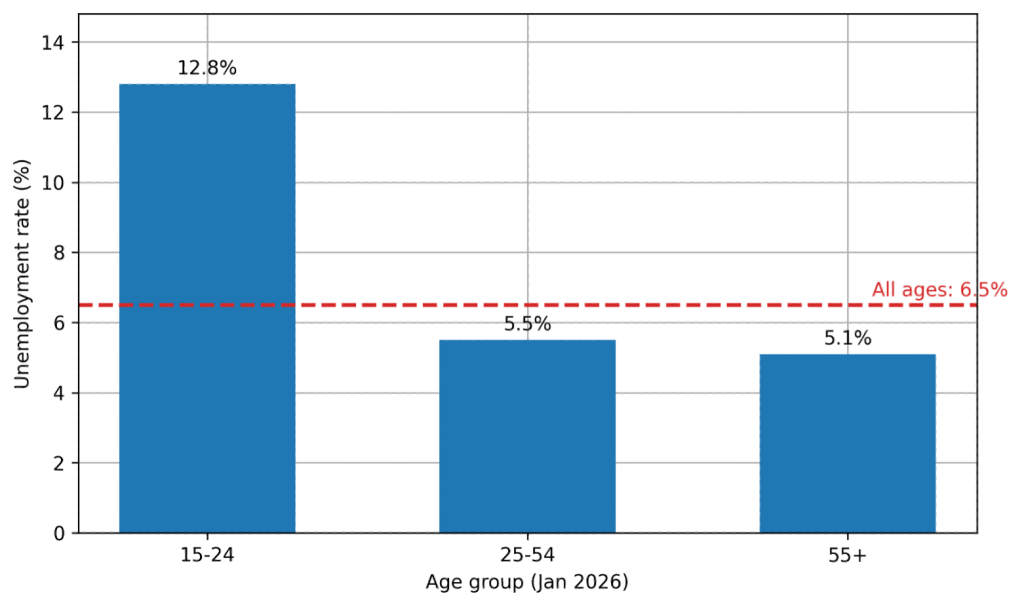
Youth unemployment remains much higher at 12.8%, despite improving from 13.3% the previous month (Figure 1).
Figure 1: Unemployment by age group, January 2026 (seasonally adjusted)
Source: Statistics Canada
Electricity utilities: Continued growth
The utilities sector added 4,200 jobs in January, bringing total employment to 174,300 (+2.5%). Sector unemployment edged down to 1.0%, remaining among the lowest across all sectors. Over the past year (January 2025 to January 2026), the sector added 18,800 jobs, representing robust annual growth of 12%.
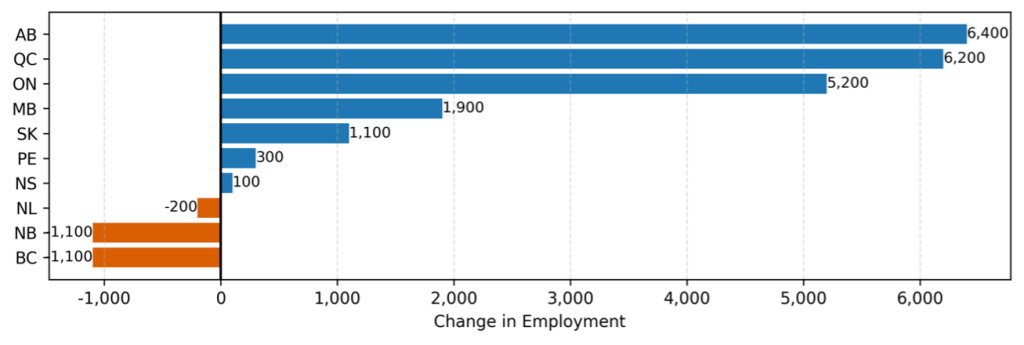
However, this growth has not been even across the country. Over the past year, Alberta, Quebec and Ontario led employment gains, while several provinces—including New Brunswick, British Columbia and Newfoundland and Labrador—experienced modest declines (Figure 2).
Figure 2: Change in utilities employment by province, January 2025–January 2026
Source: Statistics Canada
Wages: Sector softening continues
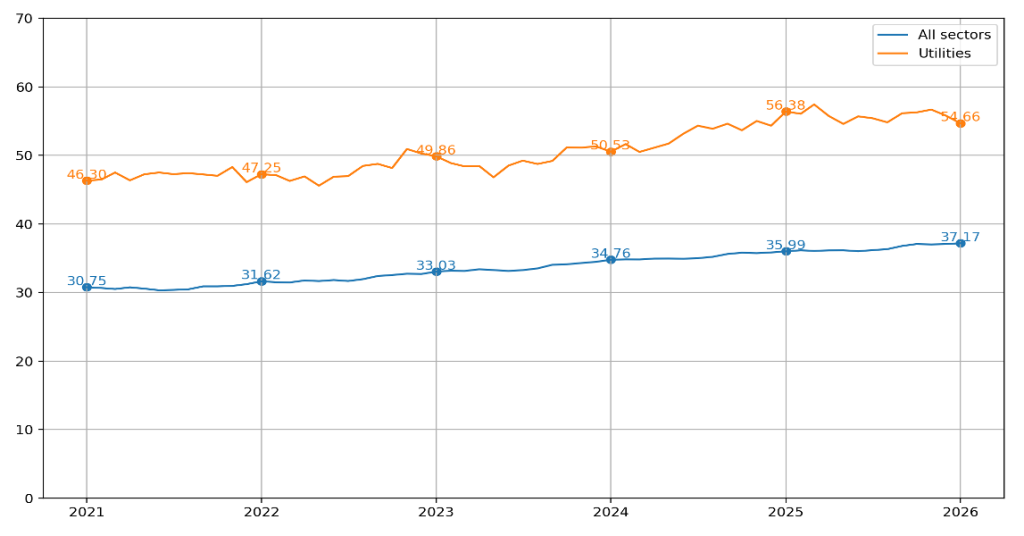
Average hourly wages in the utilities sector decreased to $54.66 in January 2026, down 2% from December and approximately 3% lower than a year earlier. Despite this softening, utilities wages remain well above the economy‑wide average of $37.17/hour. However, given that economy-wide wages grew 3.3% over the past year, while utilities wages slipped, the gap between the two narrowed slightly (Figure 3).
Over a longer horizon, the sector’s wage trajectory remains strong. Nominal utilities wages rose from $46.30/hour in January 2021 to $56.38/hour in January 2025. During the same period, average wages across all sectors increased from $30.75/hour to $35.99/hour. Despite recent softening, the sector continues to command a significant wage premium due to its higher skill requirements.
Figure 3: Average hourly wages (nominal), utilities vs all sectors: 2021–2026
Source: Statistics Canada, Table 14-10-0063-01
What to watch next month
In upcoming snapshots, EHRC will be monitoring two key developments:
- Whether January’s national job losses signal the start of a longer-term employment downturn;
- Whether utilities wages stabilize after recent softening, and whether provincial employment gains, particularly in Ontario and Saskatchewan, reflect project‑driven hiring or shifts in labour supply.