December 2025 Labour Market Snapshot
Monthly update on Canada’s labour market from an electricity sector perspective
The latest
Canada’s economy added 8,200 jobs in December 2025, a modest gain driven by an increase of 50,000 full‑time positions (+0.3%), offset by a decline of 42,000 part‑time jobs (‑1.1%), according to Statistics Canada’s December Labour Force Survey. This follows three consecutive months of growth in September, October and November, which together added 181,000 jobs (+0.9%). For 2025 overall, part‑time employment grew more quickly (2.6%) than full‑time employment (0.7%).
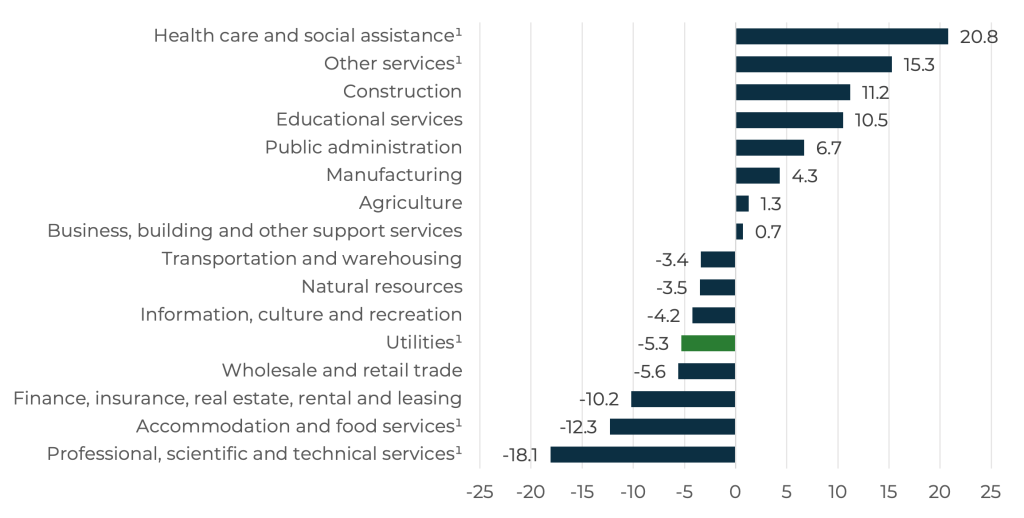
Employment gains in December were strongest in:
- Health care: +20,800
- Other services: +15,300
- Construction: +11,200
- Educational services: +10,500
Declines were concentrated in:
- Professional, scientific and technical services: ‑18,100
- Accommodation and food services: ‑12,300
- Finance, insurance, real estate, rental and leasing: ‑10,200
- Wholesale and retail trade (‑5,600) and utilities (‑5,300) also posted smaller losses
These shifts occurred amid ongoing Canada-U.S. discussions on supply‑chain security, energy investment and cross‑border competitiveness—factors that shaped business expectations and contributed to the mixed employment heading into the end of the year.
Figure 1: Monthly employment change by industry, November-December 2025 (000s, seasonally adjusted)
Source: Statistics Canada, Labour Force Survey, December 2025
Unemployment edges up
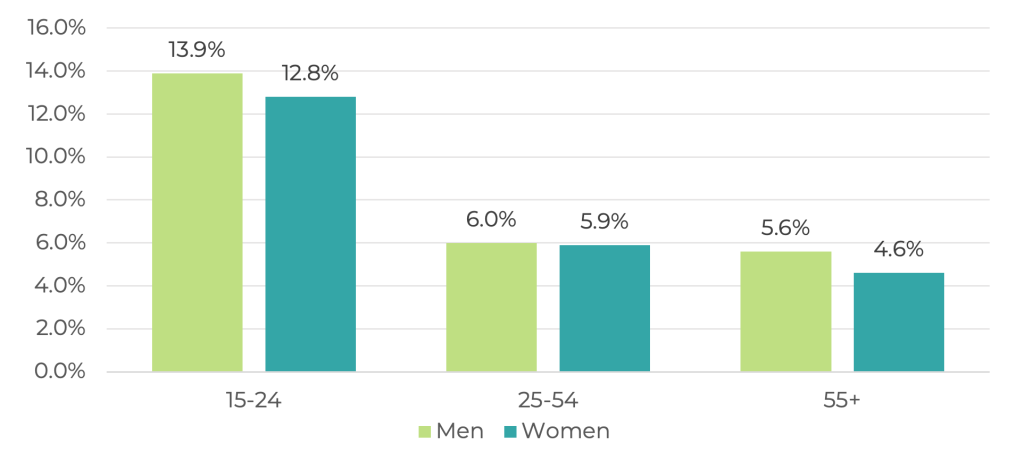
Canada’s unemployment rate rose to 6.8% in December, up from 6.5% in November, as 81,000 people entered the labour force. Youth unemployment increased slightly to 13.3% from 12.8%.
Among core‑aged workers (25–54), unemployment moved up from 5.6% to 6.0%, while older workers (aged 55+) saw a decline to 5.1% from 5.3%.
Gender differences in unemployment remained modest:
- Young men: 9%
- Young women: 8%
- Core-aged workers: 0% for men and 5.9% for women
- 55+: 6% for men (up from 5.5%), and 4.6% for women (down from 5.1%)
Figure 2: Unemployment by age and gender, December 2025 (Seasonally adjusted)
Bank of Canada holds steady
On Dec. 10, the Bank of Canada maintained its policy rate at 2.25%, pointing to “surprisingly strong” GDP growth (2.6% annualized in Q3) and stable inflation (2.2% year-over-year).
However, Canada’s CPI grew 2.4% year‑over‑year in December. Excluding energy, inflation remained near 3%, reflecting firm price growth across several service categories—consistent with ongoing wage and employment pressures as hiring momentum softened heading into 2026.
Utilities sector: Cooling after a strong year
Utilities employment declined by 5,300 (‑3%) in December, bringing total employment in the sector to 170,000. Despite the monthly dip, the sector remained up 14,200 jobs (+9.1%) from January 2025.
Provincial highlights
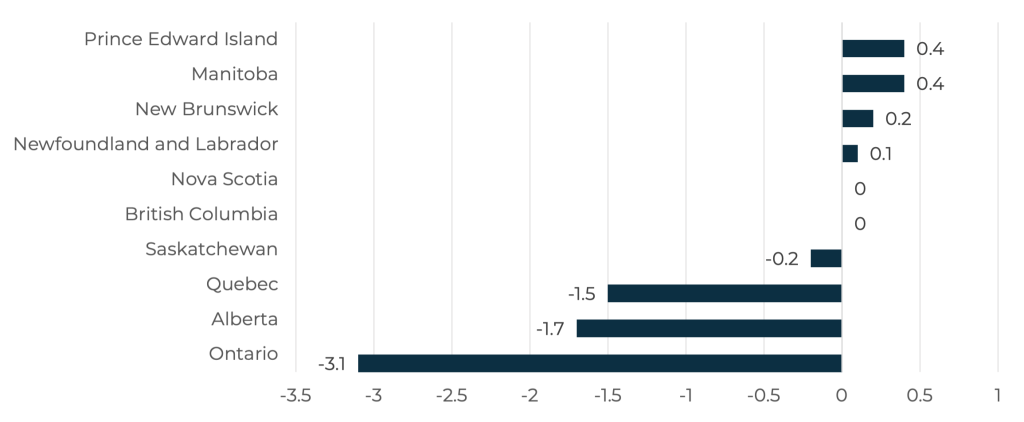
Gains were recorded in:
* EHRC has not independently verified the accuracy of this figure.
Declines occurred in:
- Ontario: -3,100 (-4%)
- Alberta: -1,700 (-1%)
- Quebec: -1,500 (-1%)
Employment was unchanged in British Columbia and Nova Scotia.
The unemployment rate in the utilities sector fell to 1.1% in December, down from 1.5% in September and 1.3% in October 2025.
Figure 3: Monthly employment change in utilities by province, December 2025 (000s)
Source: Statistics Canada, Table 14-10-0022-01
Wages remain elevated
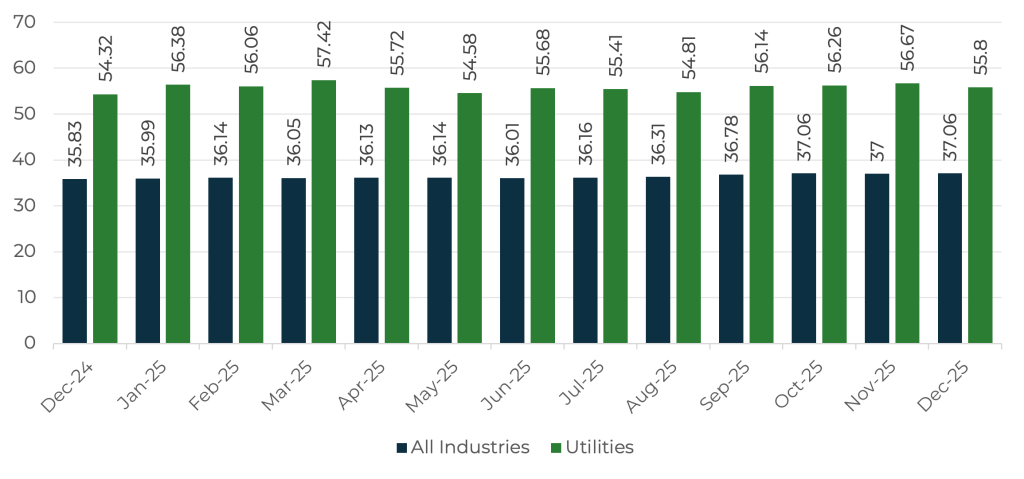
Average hourly wages in the utilities sector fell slightly from $56.67 to $55.80 (‑1.5%) in December, but remained 2.7% higher year‑over‑year.
Economy‑wide wages were steady at around $37.00, representing a 3.4% from a year ago.
Figure 4: Average hourly wages in Canada: Utilities vs. all industries, December 2024-2025