
May 2026 Labour Market Snapshot
Monthly update on the labour market in Canada’s electricity sector
Volatile labour market conditions with signs of softening in utilities
Canada’s labour market rebounded strongly in May, with broad-based employment gains bringing overall levels back to early-year highs. Within this context, the utilities sector shows signs of modest softening in recent months, as well as regional disparities. While year-over-year employment remains elevated, underlying indicators suggest more muted growth in labour input and wages.
Latest measures for the utilities sector: May 2026
| Total employment | 171,100 people |
| Monthly change in employment | -2,300 people |
| Yearly change in employment | +9,700 people |
| Average hourly wage | $54.57 |
About the snapshot
EHRC publishes a monthly labour market update focused on developments in Canada’s electricity sector. Drawing on Statistics Canada’s Labour Force Survey, this snapshot provides sector stakeholders with the latest developments on employment, unemployment, wages and emerging sector trends to support informed workforce and planning decisions.
For more information, visit ehrc.ca/labour-market-intelligence or contact us at [email protected].
Canada at a glance: Job gains surge in May, but volatility clouds the outlook
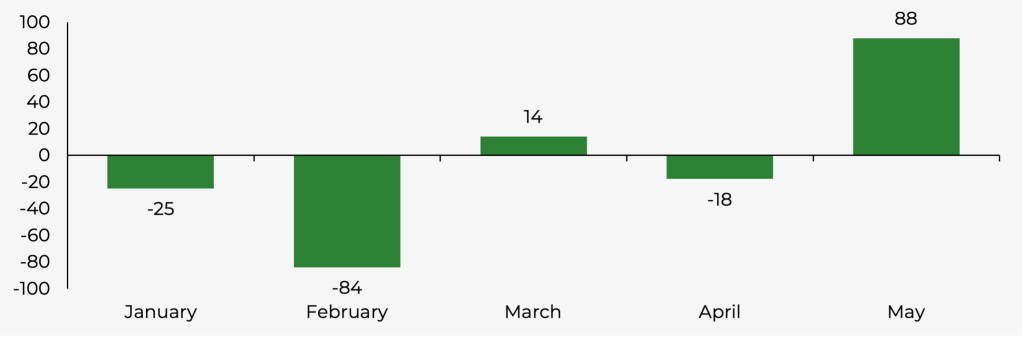
Canada’s labour market posted surprisingly strong job growth in May, with employment rising by 87,800, well above expectations and bringing employment back to January levels. The unemployment rate fell to 6.6% as hiring outpaced labour force growth, supported by broad-based gains across industries. Job growth was driven mainly by full-time positions and sectors such as construction, transportation, and services.
Still, these gains only offset losses in other months. To date in 2026, Canada has seen volatility in labour market indicators (see Figure 1).
Figure 1: Monthly change in total employment for 2026, thousands, seasonally adjusted
Source: Statistics Canada, Table 14-10-0355-02
Regional disparities shape modest contraction in utilities employment
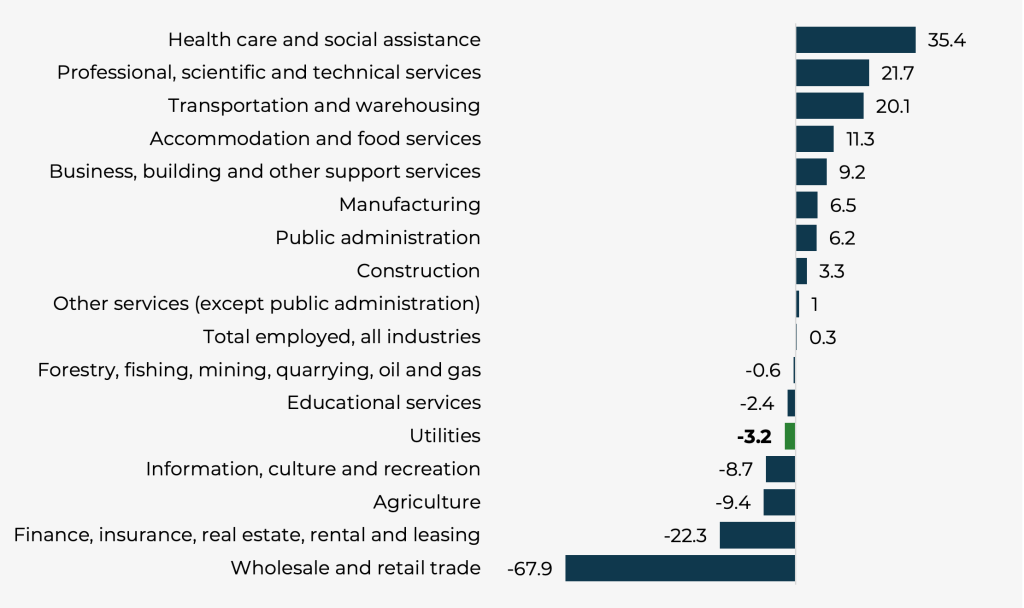
Employment in the utilities sector edged down for a second month in a row in May, declining by 2,300 to 171,100. So far in 2026, employment has slipped by a cumulative 3,200, pointing to a potential softening in staffing levels (Figure 2). Compared with other sectors, employment in the utilities sector appears stable.
Figure 2: Year-to-date change in employment in Canada by sector, May 2026, Thousands
Source: Statistics Canada, Table 14-10-0355-02
The May decline was geographically concentrated, with the largest contractions in Saskatchewan (-1,600) and Alberta (-1,100), potentially reflecting project-related fluctuations or timing effects in capital-intensive activities. These losses were partially offset by gains in Quebec (+1,200), highlighting uneven regional dynamics within the sector.
Despite this recent pullback, the sector continues to register the strongest year‑over‑year growth (+6.0%), suggesting that underlying demand for labour remains elevated relative to the rest of the economy.
Electricity drives payroll growth in the utilities sector
While the Labour Force Survey measures total employment for the entire utilities sector (NAICS 22), another source of data, the Survey of Employment, Payrolls and Hours, provides measures of payroll employment specific to the electricity sector (NAICS 2211). The downside is that this alternative source is slightly less recent (with a further two-month lag).
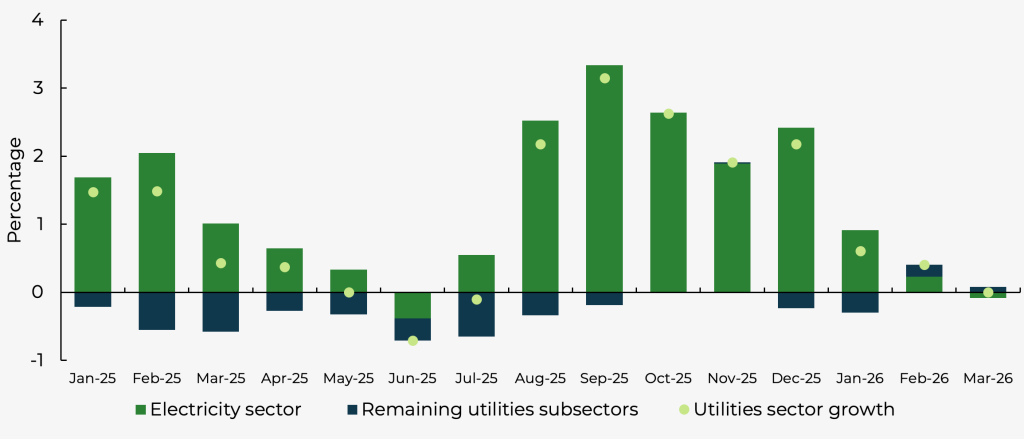
This source makes it clear that the electricity sector has been a key contributor to payroll employment[1] growth in the utilities sector in most months. Its contribution was especially strong from August to December 2025, when it added roughly 2 percentage points or more to year-over-year growth in utilities payroll employment. However, this positive contribution was often partly offset by negative contributions from the remaining utilities subsectors (Figure 3). In fact, while the electricity sector has added payroll employment in 13 of the past 15 months, the other utilities subsectors have added payroll employment in only two. Overall, the data suggest that recent payroll employment gains in utilities have been concentrated in electricity, while the rest of the sector has been experiencing losses.
Figure 3: Contribution to year-over-year payroll employment growth for the utilities sub-sectors, percentage points
Source: Statistics Canada, Table 14-10-0220-01
What to watch next month
The next release will help clarify whether recent stability marks a turning point or a pause in a broader slowdown. Monitoring the breadth and persistence of employment declines will be key to assessing underlying labour demand.
Footnotes
[1] This report uses two complementary data sources. The Labour Force Survey (LFS) measures the number of people employed (including self‑employed) based on a household survey, making it the timeliest indicator of overall employment but more volatile, especially in smaller sectors. The Survey of Employment, Payrolls and Hours (SEPH) is based on employer payroll data and measures paid employee jobs only, excluding the self‑employed. It is more stable and detailed by industry but released with a lag and may count multiple jobs per person.