
April 2026 Labour Market Snapshot
Monthly update on the labour market in Canada’s electricity sector
Utilities employment fluctuates as the national labour market continues to stabilize
National employment declined slightly in April, falling 18,000 jobs. The smaller variations of the past two months follow significant declines earlier in the year, resulting in a net decline of 112,000 jobs year-to-date. The unemployment rate ticked upward by 0.2% to 6.9%. Utilities employment has grown strongly over the past year, but this increase in headcount has likely outpaced gains in hours worked.
About the snapshot
EHRC publishes a monthly labour market update focused on developments in Canada’s electricity sector. Drawing on Statistics Canada’s Labour Force Survey, this snapshot provides sector stakeholders with the latest developments on employment, unemployment, wages and emerging sector trends to support informed workforce and planning decisions.
For more information, visit ehrc.ca/labour-market-intelligence or contact us at [email protected]
Canada at a glance: An unsettled labour market
After showing signs of stabilizing in March, the Canadian economy continued its trend of job losses. In April, the Canadian economy erased March’s gains by dropping 18,000 positions. The unemployment rate crept up from 6.7% to 6.9%. Together, these developments point to a labour market that remains fragile, with limited momentum and growing signs of labour market slack.
Utilities employment edges downwards, but still showing strong annual growth in headcount
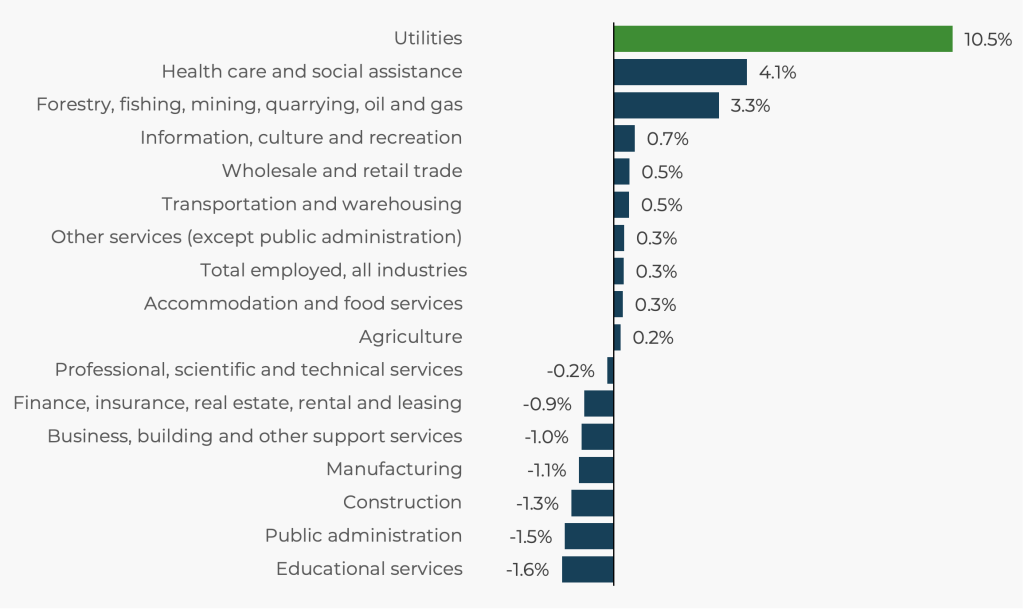
Employment in the utilities sector fell by 3,500 workers in April, bringing total employment to 173,300. Despite this modest loss over the previous month, the sector continues to outperform on a year-over-year basis. Between April 2025 and April 2026, utilities employment expanded by 16,500 positions, a 10.5% increase, marking the strongest growth rate across all sectors (See Figure 1).
Although utilities account for a relatively small share of total employment, their sustained expansion contrasts sharply with the stagnation or contraction observed in many larger industries. This difference underscores the sector’s relative resilience.
The underlying dynamics suggest that utilities are increasingly playing a stabilizing role within the broader labour market. This resilience is likely supported by structural factors, including long-term infrastructure investment cycles, ongoing system reliability requirements and demand for highly specialized labour. These characteristics make the sector less sensitive to short-term economic fluctuations compared to more cyclical industries.
Figure 1: Annual change in employment in Canada by sector, April 2025–April 2026
Source: Statistics Canada. Table 14-10-0355-02
Utilities headcount may be outpacing actual labour growth
While utilities headcount has growth substantially over the past year, actual hours worked may not have grown as quickly. While the Labour Force Survey measures total employment including both employees and the self‑employed, another source of data, the Survey of Employment, Payrolls and Hours, provides a more direct measure of employer-based (payroll) jobs and thus hours worked in payroll jobs.
While the headcount grew 10.5% in the utilities sector from April 2025 to April 2026, the number of full-time equivalent positions grew from 0.7% from February 2025 to February 2026 (February is the latest available data for the Survey of Employment, Payroll and Hours.) The difference between the two estimates suggests that the strong employment gains observed in headcount may not fully reflect a broad expansion in work. Instead, the headcount growth may be driven by non-payroll employment or compositional shifts.
Wage growth remains steady economy-wide; utilities wages decline
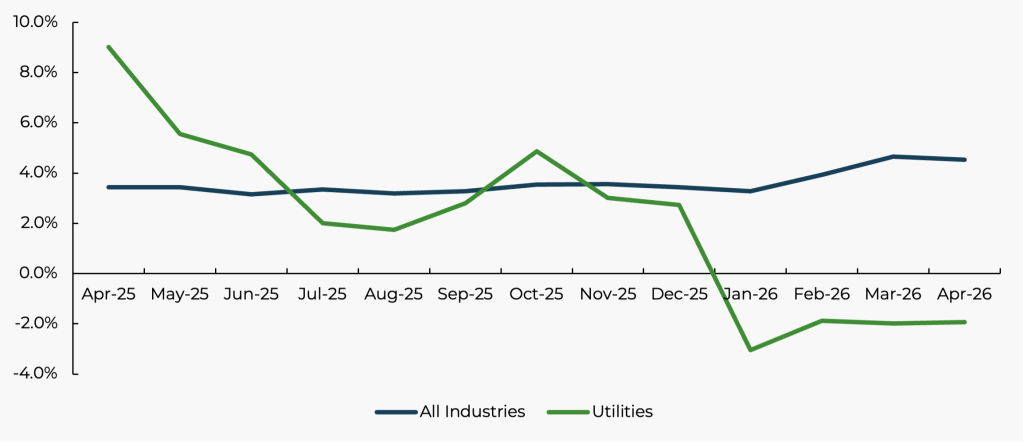
Average hourly wages across all sectors reached $37.77 per hour in April 2026, up 4.5% from one year earlier. In comparison, utilities workers earned an average of $54.64 per hour, down 1.9% from April 2025 but still roughly $17 higher than the economy‑wide average. While wages in the economy have made steady gains, wage growth in the utilities sector has been slower since late 2025 and in fact has been slightly negative throughout 2026 (see Figure 2).
The stagnation in utilities wages, despite strong headcount gains, may also support a disconnect between employment and labour utilization, as headcount growth has likely not translated into proportional increases in payroll hours worked, suggesting more contract/ part-time workers or lower average hours that can put downward pressure on average wages.
Figure 2: Year-on-year growth in average hourly wages, utilities vs all industries
Source: Statistics Canada. Table 14-10-0063-01
What to watch next month
Attention will focus on whether recent signs of labour market stabilization can be sustained amid ongoing economic uncertainty. It will be important to assess whether employment declines remain modest or begin to broaden across sectors, signaling a more persistent weakening in labour demand.