
February 2026 Labour Market Snapshot
Monthly update on the labour market in Canada’s electricity sector
Utilities continue to show strength as the national labour market weakens
While overall economic momentum stalled in February—with job losses mounting and unemployment edging higher—the utilities sector continues to stand out for its stability. Strong year‑over‑year job growth and sustained wages highlight the sector’s resilience despite a slowing national economy.
About the snapshot
EHRC publishes a monthly labour market update focused on developments in Canada’s electricity sector. Drawing on Statistics Canada’s Labour Force Survey, this snapshot provides sector stakeholders with the latest developments on employment, unemployment, wages and emerging sector trends to support informed workforce and planning decisions.
For more information, visit ehrc.ca/labour-market-intelligence or contact us at [email protected].
Canada at a glance: Labour market cools further
Canada’s labour market softened further in February, with employment declining by an estimated 84,000 jobs and unemployment rising from 6.5% to 6.7%. Analysts attribute much of this weakness to ongoing trade uncertainty affecting export‑oriented industries such as automotive, lumber, and metals.
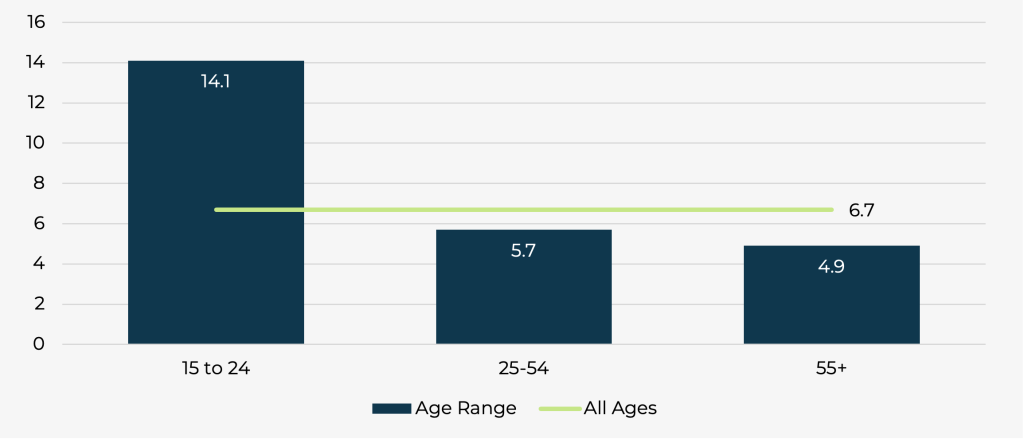
Youth continue to face disproportionate challenges: unemployment for Canadians aged 15–24 rose from 12.8% to 14.1%, more than double the national average. Unemployment also edged up among core‑aged workers (25–54)n from 5.5% to 5.7%, while workers aged 55+ saw a slight improvement with unemployment, from 5.1% to 4.9%.
Figure 1: Unemployment (%) by age group, February 2026
Source: Statistics Canada
Utilities employment continues to rise
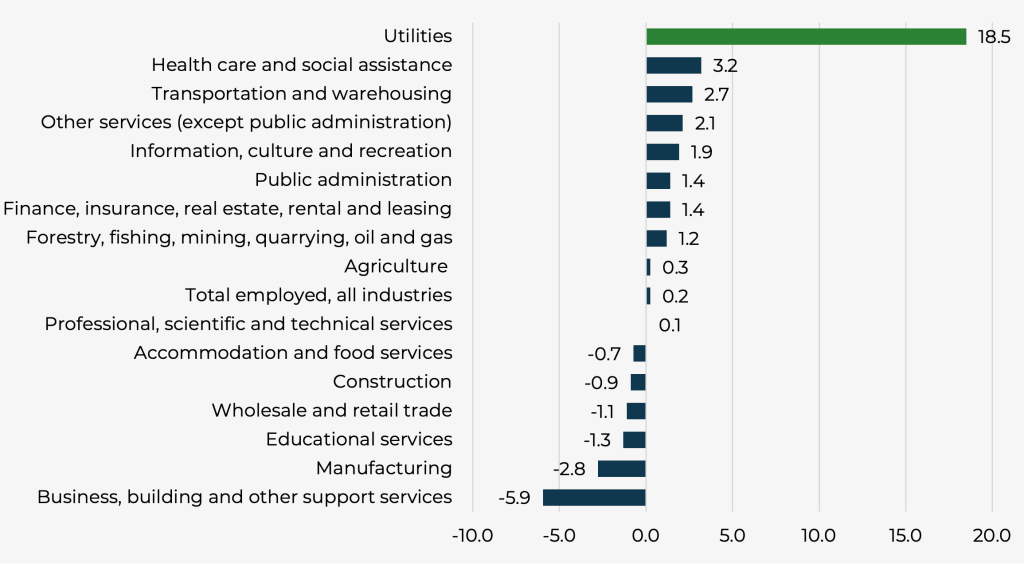
Employment in Canada’s utilities sector grew by 1,800 positions (+1.0%) in February, bringing the sector to 176,700 jobs. Year over year, the sector added 27,500 positions—an 18.5% increase and the strongest growth of any industry group.
Other sectors posted far more modest annual gains, including health care and social assistance (+3.2%) and transportation and warehousing (+2.7%). Utilities remains the only sector showing this level of growth.
Figure 2: Change in employment by sector (%), February 2025–February 2026
Source: Statistics Canada
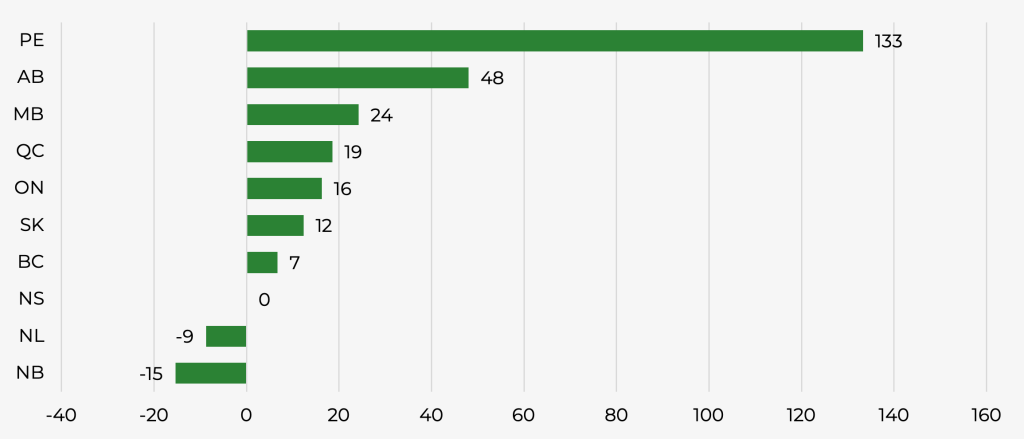
The growth is not consistent across Canada. Alberta led with a striking 48% increase in utilities employment over the past year, followed by Manitoba (+24%) and Quebec (+19%). Prince Edward Island’s small labour pool contributed to a sharp statistical increase (+133%), more than doubling over the past year—although a degree of caution should be applied for such a small pool.
Figure 3: Change in utilities employment by province, February 2025–February 2026
Source: Statistics Canada
Sector wages have plateaued
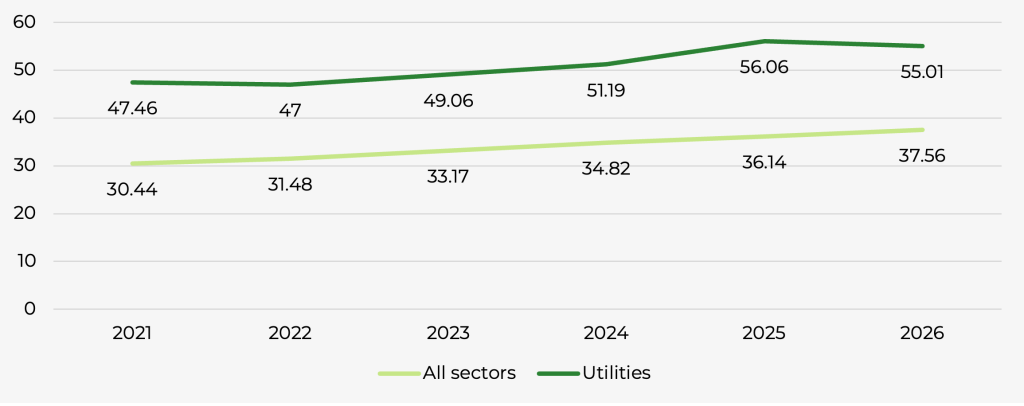
Despite the job losses, wages across the economy rose 3.9% year over year, continuing an upward trend since 2021. In contrast, utilities wages—among the highest of any industry—have plateaued after several years of strong growth. Average utilities wages were $55.01 in February, down slightly from their February 2025 peak of $56.06.
Even with this softening, utilities workers continue to earn nearly 50% more than the economy‑wide average of $37.56.
Figure 4: Average hourly wages, utilities vs all sectors: February 2021–February 2026
Source: Statistics Canada
What to watch next month
In March, EHRC will be watching whether February’s large job losses point to a deeper economic slowdown and whether the utilities sector can maintain strong employment momentum despite weakening national conditions.