
July 2026 Labour Market Snapshot
Monthly update on the labour market in Canada’s electricity sector
Broad-based employment gains with continued utilities softening
Canada’s labour market strengthened in July, with employment up by 75,000 and the unemployment rate declining to 6.4%, driven by broad-based employment gains to its lowest level in two years. Utilities employment remained largely unchanged, with modest job losses. The modest national dip to utilities employment over the past quarter hides considerable variation across provinces.
Latest measures for the utilities sector: July 2026
|
162,200 |
|
−1.0% |
|
+1.6% |
|
$55.43 |
About the snapshot
EHRC publishes a monthly labour market update focused on developments in Canada’s electricity sector. Drawing on Statistics Canada’s Labour Force Survey, this snapshot provides sector stakeholders with the latest developments on employment, unemployment, wages and emerging sector trends to support informed workforce and planning decisions.
For more information, visit ehrc.ca/labour-market-intelligence or contact us at [email protected].
Canada at a glance: Continued employment gains
After stalling in June, Canada’s labour market picked up again in July. Employment increased by 75,000, driving the unemployment rate to its lowest level since July 2024. Most of the employment growth was concentrated among private sector (+57,900, +1.2%) and self-employed (+44,400, +1.5%) workers, with an overall decline in the number of public sector employees (-27,000, -0.4%). Despite the large increase in the number of jobs, the unemployment rate fell only 0.1% due to a nearly proportionate increase in the labour force by 60,500 persons. These changes were due to both an increase in the working age population and a slight uptick in the participation rate.
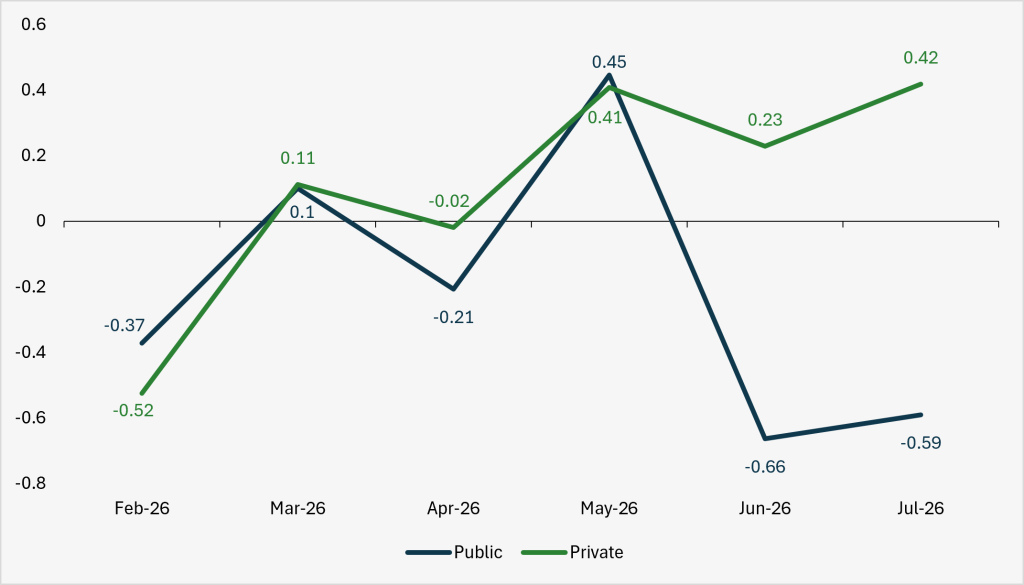
The public and private sector largely mirrored each other between January and May before diverging in June. Since then, the public sector has shed 57,500 jobs (-1.3%), including 27,000 jobs (-0.59%) in July (Figure 1). The public sector is expected to intermittently experience losses over the next few years, particularly at the federal level. The federal government’s Budget 2025 asked most departments to reduce spending up to 15% within three years. Because these reductions will be phased in, the job losses may be expected to come in spurts, possibly with brief periods of growth in between.
Figure 1: Month over month percent change in total employment by sector, seasonally adjusted
Source: Statistics Canada, Table 14-10-0288-02
Regional disparities shape modest softening in utilities employment
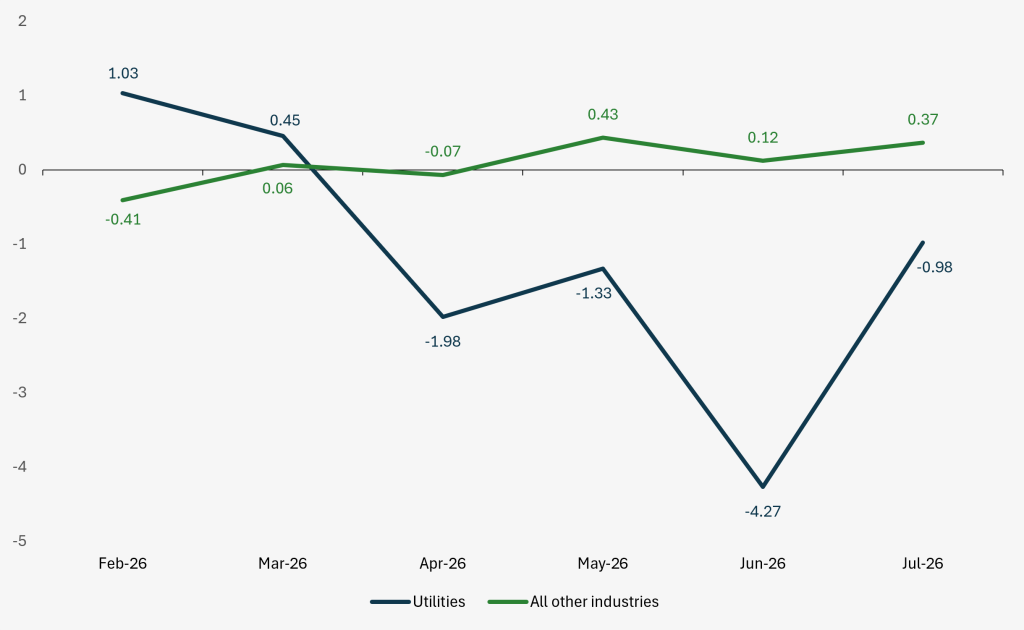
While the national workforce continued to grow in July, utilities employment declined by a further 1,600 positions to 162,200. Although this marked a fourth consecutive monthly decline (Figure 2), the 0.98% decrease was the smallest of the four (Figure 2). The sector had previously shown considerable strengthen. Even with recent losses, utilities employment remains slightly above (+1.6%) where it was a year ago.
Figure 2: Month over month percent change in employment in Canada by industry, thousands, seasonally adjusted
Source: Statistics Canada, Table 14-10-0355-02
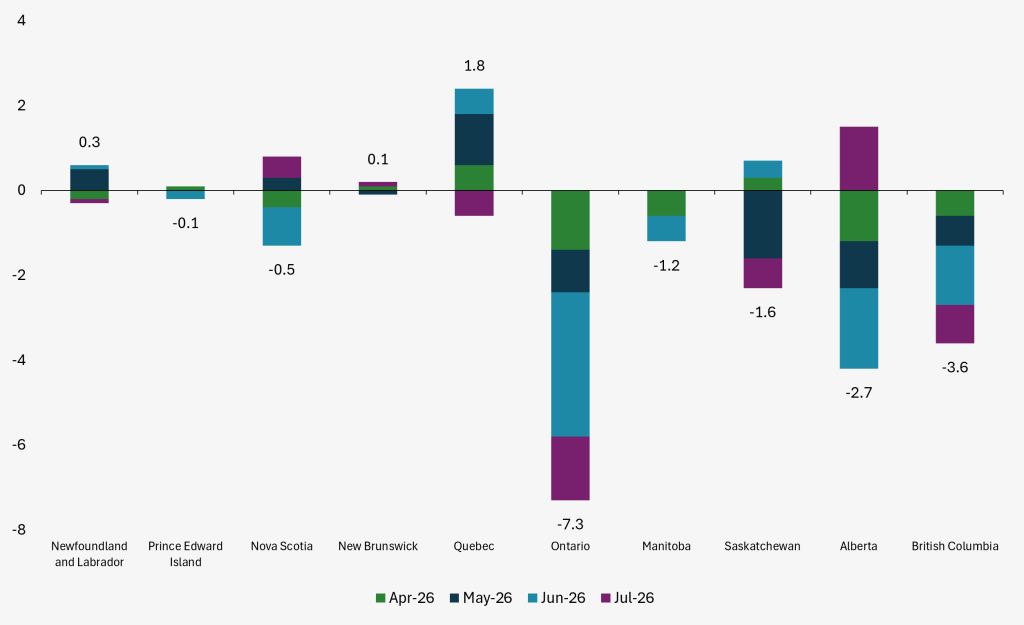
While aggregate job losses in the utilities sector were moderate this month, the picture varied considerably across provinces. Employment gains in some provinces have largely offset losses elsewhere. For instance, Quebec posted a monthly loss after months of gains and Alberta posted a monthly gain after months of losses. In two provinces, the jobs losses are more persistent. Ontario and British Columbia continued to experience job losses, now down 7,300 (10%) and 3,600 (20%) since March, respectively.
Figure 3: Month-over-month changes in utilities employment by province, thousands
Source: Statistics Canada, Table 14-10-0355-02
What to watch in the coming months
Upcoming releases will help clarify whether recent employment declines are a temporary normalization following last year’s strong growth, or the beginning of a more sustained slowdown. Despite recent losses, year over year employment is still positive.