
March 2026 Labour Market Snapshot
Monthly update on the labour market in Canada’s electricity sector
Utilities continue to show resilience as the national labour market stabilizes
Although Canada’s economy registered significant job losses earlier in 2026, the nation’s labour market stabilized in March with the unemployment rate remaining stable at 6.7%. The utilities sector continued to demonstrate relative strength, supported by strong year‑over‑year employment growth and elevated wages.
About the snapshot
EHRC publishes a monthly labour market update focused on developments in Canada’s electricity sector. Drawing on Statistics Canada’s Labour Force Survey, this snapshot provides sector stakeholders with the latest developments on employment, unemployment, wages and emerging sector trends to support informed workforce and planning decisions.
For more information, visit ehrc.ca/labour-market-intelligence or contact us at [email protected].
Canada at a glance: Labour market steadies
After cumulative job losses in January and February, employment stabilized in March, rising modestly by 14,000 positions. The unemployment rate, unchanged at 6.7%, suggests that labour market conditions may be stabilizing after cooling earlier in the year.
Utilities employment remains a bright spot
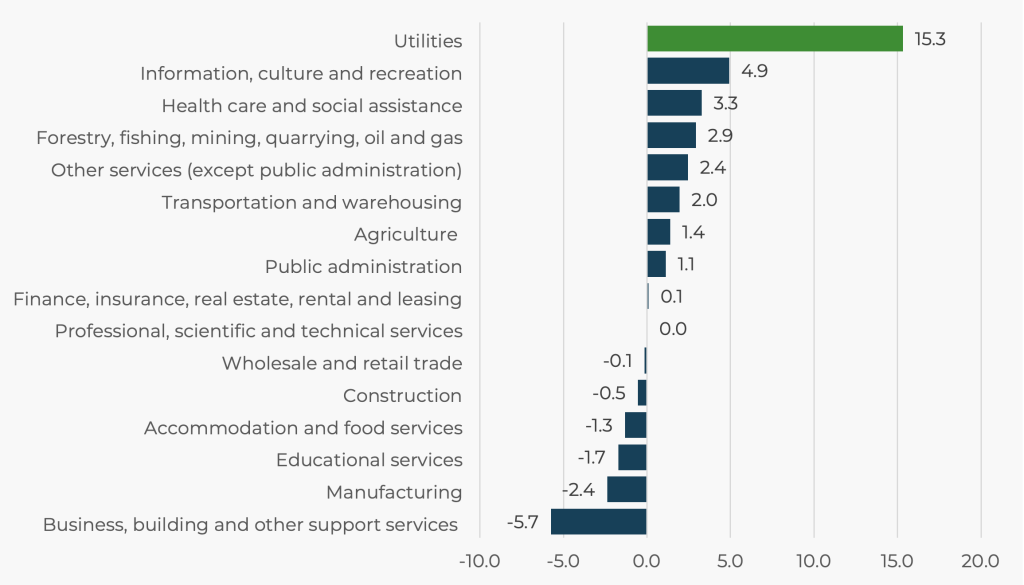
Utilities employment increased by approximately 15.3% between March 2025 and March 2026, representing an estimated gain of 15,000 jobs and bringing total sector employment to about 110,000 workers. This year‑over‑year growth reinforces utilities as one of the strongest‑performing sectors nationally and stands in contrast to stable and in places contracting employment across much of the economy.
Utilities’ growing role amid broader labour market cooling
As overall employment growth in Canada slowed over the past year, utilities accounted for a rising share of net job gains across industries. While utilities represent a relatively small share of total national employment, strong year‑over‑year growth in the sector contrasted with stagnation or contraction in many larger industries.
This pattern suggests that utilities are playing an increasingly stabilizing role in the labour market, supported by long‑term infrastructure investment, system reliability requirements and specialized workforce needs that are less sensitive to near‑term pressures.
Figure 1: Change in employment by sector, March 2025–March 2026
Source: Statistics Canada, Table 14-10-0355-02
Wage growth accelerates economy-wide; utilities wages remain elevated.
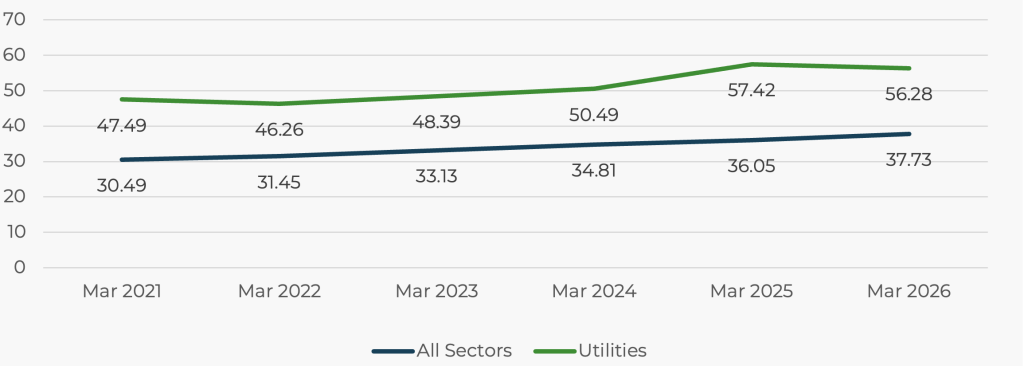
Average hourly wages across all sectors reached $37.73 per hour in March 2026, up from $36.05 one year earlier. In comparison, utilities workers earned an average of $56.28 per hour, down slightly from $57.42 in March 2025 but still roughly $19 higher than the economy‑wide average. This ongoing wage premium highlights continued labour market tightness and the specialized skill requirements of the utilities sector.
Figure 2: Average hourly wages, utilities vs all sectors: March 2021–March 2026
Source: Statistics Canada
What to watch next month
Attention will focus on whether signs of labour market stabilization persist amid ongoing economic uncertainty and whether utilities can sustain elevated employment and wage levels given long‑term infrastructure investment needs and system reliability requirements.